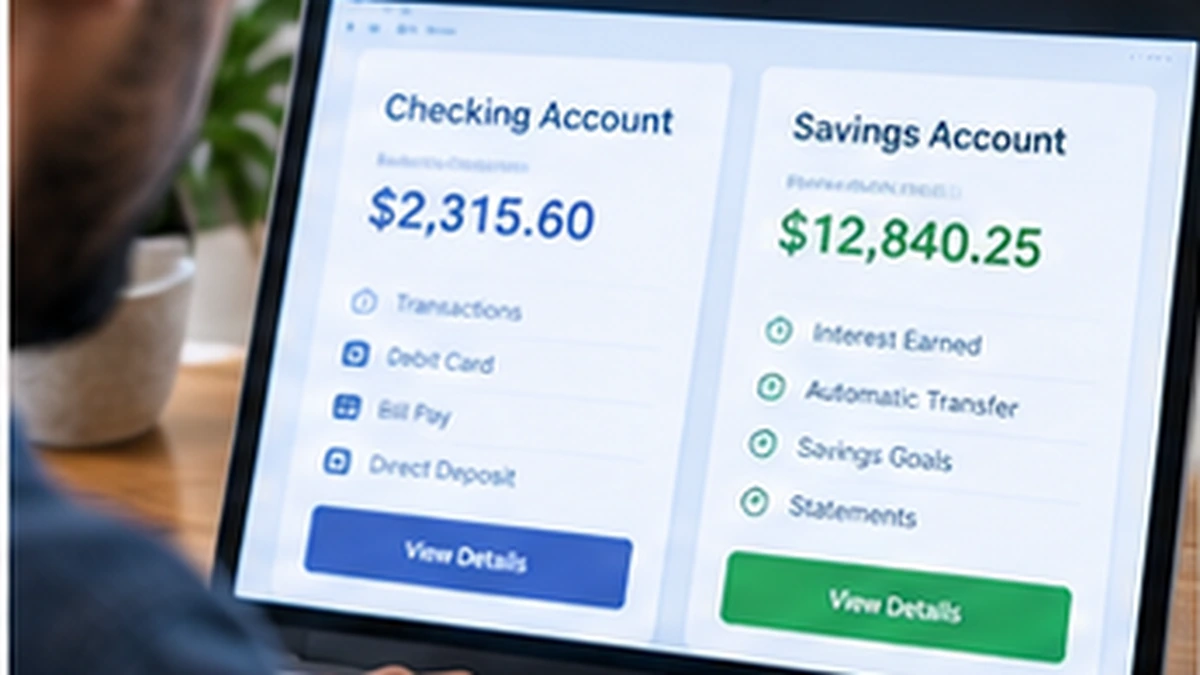
Checking vs savings account Checking and savings accounts are both deposit accounts, but they usually serve different jobs. One is designed around frequent transactions while the other is commonly used to hold money for goals, reserves, or expenses that are not due immediately.
This guide explains checking vs savings account for general financial education. It does not provide individualized investment, tax, legal, credit, or banking advice. Some authoritative sources are U.S.-focused, so readers elsewhere should verify local rules and product terms with the appropriate authority.
Why checking vs savings account matters
A simple account design is to give each account one clear job. Checking handles current obligations, savings protects future obligations, and investment accounts serve longer-term risk-taking goals. When account roles are clear, transfers and balances become easier to interpret.
Use checking for frequent transactions
Checking accounts commonly support bill payment, debit purchases, transfers, ATM access, and direct deposit, depending on the institution and account.
For checking vs savings account, connect this section to one real number, account, report item, contribution, or decision in your own finances. Review checkpoint 1: write the relevant amount, date, fee, balance, or goal so the idea can be tested rather than remaining theoretical.
Use savings for money you want to separate
Savings accounts are generally better suited to emergency reserves and future goals because the balance is not mixed with ordinary daily transactions.
For checking vs savings account, connect this section to one real number, account, report item, contribution, or decision in your own finances. Review checkpoint 2: write the relevant amount, date, fee, balance, or goal so the idea can be tested rather than remaining theoretical.
Compare interest rates
Savings accounts often pay interest, while some checking accounts pay little or none. Rates can change, so review current terms instead of relying on old assumptions.
For checking vs savings account, connect this section to one real number, account, report item, contribution, or decision in your own finances. Review checkpoint 3: write the relevant amount, date, fee, balance, or goal so the idea can be tested rather than remaining theoretical.
Review monthly and transaction fees
Maintenance fees, ATM charges, wire fees, and other costs can erase the value of a higher interest rate if the account does not fit your behavior.
For checking vs savings account, connect this section to one real number, account, report item, contribution, or decision in your own finances. Review checkpoint 4: write the relevant amount, date, fee, balance, or goal so the idea can be tested rather than remaining theoretical.
Check minimum-balance rules
Some accounts waive fees or pay better rates only when a required balance is maintained. Know which balance rule applies and what happens when it is missed.
For checking vs savings account, connect this section to one real number, account, report item, contribution, or decision in your own finances. Review checkpoint 5: write the relevant amount, date, fee, balance, or goal so the idea can be tested rather than remaining theoretical.
Understand deposit insurance
FDIC explains that checking and savings accounts at FDIC-insured banks are deposit products covered under FDIC insurance rules and ownership categories.
For checking vs savings account, connect this section to one real number, account, report item, contribution, or decision in your own finances. Review checkpoint 6: write the relevant amount, date, fee, balance, or goal so the idea can be tested rather than remaining theoretical.
Do not confuse deposits with investments
Stocks, bonds, mutual funds, and other non-deposit investments are not covered by FDIC deposit insurance simply because a bank or financial company offers them.
For checking vs savings account, connect this section to one real number, account, report item, contribution, or decision in your own finances. Review checkpoint 7: write the relevant amount, date, fee, balance, or goal so the idea can be tested rather than remaining theoretical.
Use both account types together
Many households keep bill money in checking and transfer goal or emergency money to savings so each balance has a clearer purpose.
For checking vs savings account, connect this section to one real number, account, report item, contribution, or decision in your own finances. Review checkpoint 8: write the relevant amount, date, fee, balance, or goal so the idea can be tested rather than remaining theoretical.
Review overdraft settings
Know how the account handles insufficient funds, whether overdraft fees apply, and whether low-balance alerts or linked-account protection are available.
For checking vs savings account, connect this section to one real number, account, report item, contribution, or decision in your own finances. Review checkpoint 9: write the relevant amount, date, fee, balance, or goal so the idea can be tested rather than remaining theoretical.
Choose the account around your habits
Branch access, online banking, direct deposit, cash use, transfer speed, customer service, interest, and fees can matter more than the account label itself.
For checking vs savings account, connect this section to one real number, account, report item, contribution, or decision in your own finances. Review checkpoint 10: write the relevant amount, date, fee, balance, or goal so the idea can be tested rather than remaining theoretical.
A realistic example of checking vs savings account
A person wants to improve this part of their finances and initially focuses on one attractive number, such as a high rate, low fee, strong score, or recent return. After reviewing the full account terms, budget, risk, time horizon, and goal, the person chooses a plan that is easier to maintain. The example shows why checking vs savings account should be connected to the whole financial picture rather than one headline figure.
Connect this guide to the rest of the finance site
Read monthly budget for one related finance topic, and use emergency fund when the second guide helps you understand saving, credit, investing, retirement, or financial safety.
These internal links connect the first Finance batch so readers can move between budgeting, banking, credit, investing, retirement, and fraud protection without repeating the same article.
A seven-day review plan for checking vs savings account
Day 1: define the goal. Day 2: collect the relevant account, statement, report, or budget data. Day 3: compare the information with the authoritative source below. Day 4: identify costs, risks, and missing information. Day 5: make one small adjustment. Day 6: verify that the change worked as intended. Day 7: record the next step and a date to review the result again. Finance review note 3 for checking vs savings account.
The seven-day structure is only a framework. A credit-report correction or account transfer can require more time, while a simple budget or savings update may take less than an hour.
Practical checklist
- Purpose of checking vs savings account identified
- Current financial information collected
- Costs, fees, or risks reviewed
- Authoritative source checked
- Assumptions separated from facts
- Privacy and security considered
- One practical next step selected
- Review date scheduled
Use the checklist to find the weakest part of your understanding of checking vs savings account. One overlooked fee, report error, concentration risk, or security problem can matter more than several details you already understand.
Frequently Asked Questions
Is there one financial strategy that works for everyone?
No. Income, expenses, goals, time horizon, taxes, debt, risk tolerance, and local rules differ. General frameworks should be adapted to the person’s actual situation.
Should short-term savings and long-term investments be handled the same way?
Usually not. Money needed soon generally needs more stability and access, while long-term investing can accept more market fluctuation depending on risk tolerance and the goal.
Can one financial number tell me whether a decision is good?
No. A rate, score, return, fee, or balance is only part of the picture. Review the product terms, cash-flow effect, risk, and goal together.
Where should I verify financial information?
Use the bank, regulator, tax authority, securities regulator, credit-reporting company, or other official source with authority over the product or issue in your jurisdiction.
Practical review 1 for checking vs savings account
Take one real account, statement, report, or savings goal and explain it in plain language. Identify the amount involved, the cost or risk, what can change, and what action would improve the situation. If any part depends on a rule or product term you cannot verify, check it before acting. Finance review note 9 for checking vs savings account.
Then compare the current approach with one realistic alternative. The goal is not to find a perfect financial answer; it is to understand the trade-off well enough to choose the next step deliberately and to know what evidence would make you change that decision later. Finance review note 9 for checking vs savings account.
Practical review 2 for checking vs savings account
Take one real account, statement, report, or savings goal and explain it in plain language. Identify the amount involved, the cost or risk, what can change, and what action would improve the situation. If any part depends on a rule or product term you cannot verify, check it before acting. Finance review note 10 for checking vs savings account.
Then compare the current approach with one realistic alternative. The goal is not to find a perfect financial answer; it is to understand the trade-off well enough to choose the next step deliberately and to know what evidence would make you change that decision later. Finance review note 10 for checking vs savings account.
Practical review 3 for checking vs savings account
Take one real account, statement, report, or savings goal and explain it in plain language. Identify the amount involved, the cost or risk, what can change, and what action would improve the situation. If any part depends on a rule or product term you cannot verify, check it before acting. Finance review note 11 for checking vs savings account.
Then compare the current approach with one realistic alternative. The goal is not to find a perfect financial answer; it is to understand the trade-off well enough to choose the next step deliberately and to know what evidence would make you change that decision later. Finance review note 11 for checking vs savings account.
Practical review 4 for checking vs savings account
Take one real account, statement, report, or savings goal and explain it in plain language. Identify the amount involved, the cost or risk, what can change, and what action would improve the situation. If any part depends on a rule or product term you cannot verify, check it before acting. Finance review note 12 for checking vs savings account.
Then compare the current approach with one realistic alternative. The goal is not to find a perfect financial answer; it is to understand the trade-off well enough to choose the next step deliberately and to know what evidence would make you change that decision later. Finance review note 12 for checking vs savings account.
Practical review 5 for checking vs savings account
Take one real account, statement, report, or savings goal and explain it in plain language. Identify the amount involved, the cost or risk, what can change, and what action would improve the situation. If any part depends on a rule or product term you cannot verify, check it before acting. Finance review note 13 for checking vs savings account.
Then compare the current approach with one realistic alternative. The goal is not to find a perfect financial answer; it is to understand the trade-off well enough to choose the next step deliberately and to know what evidence would make you change that decision later. Finance review note 13 for checking vs savings account.
Authoritative resource to review
For an authoritative reference related to this topic, review FDIC – Deposit Products That Are Insured. Use the source for the core principle, then verify the exact account terms, local rules, and personal circumstances before acting.
Final perspective
Checking vs savings account becomes easier when the process is simple enough to repeat. Use real numbers, keep records, understand risk, protect accounts, and review the plan periodically instead of relying on one-time decisions or financial promises.
Leave a Reply